
Seedream 5.0 Pro: why '16:9' in your prompt does nothing, and what to write instead
Seedream 5.0 Pro has no aspect ratio parameter. The shape lives in size, written as WIDTH*HEIGHT with an asterisk, and a ratio typed into the caption is ignored. Here are the thirteen legal sizes, the thinking switch, and the caption it rewards. From 144 credits per image.
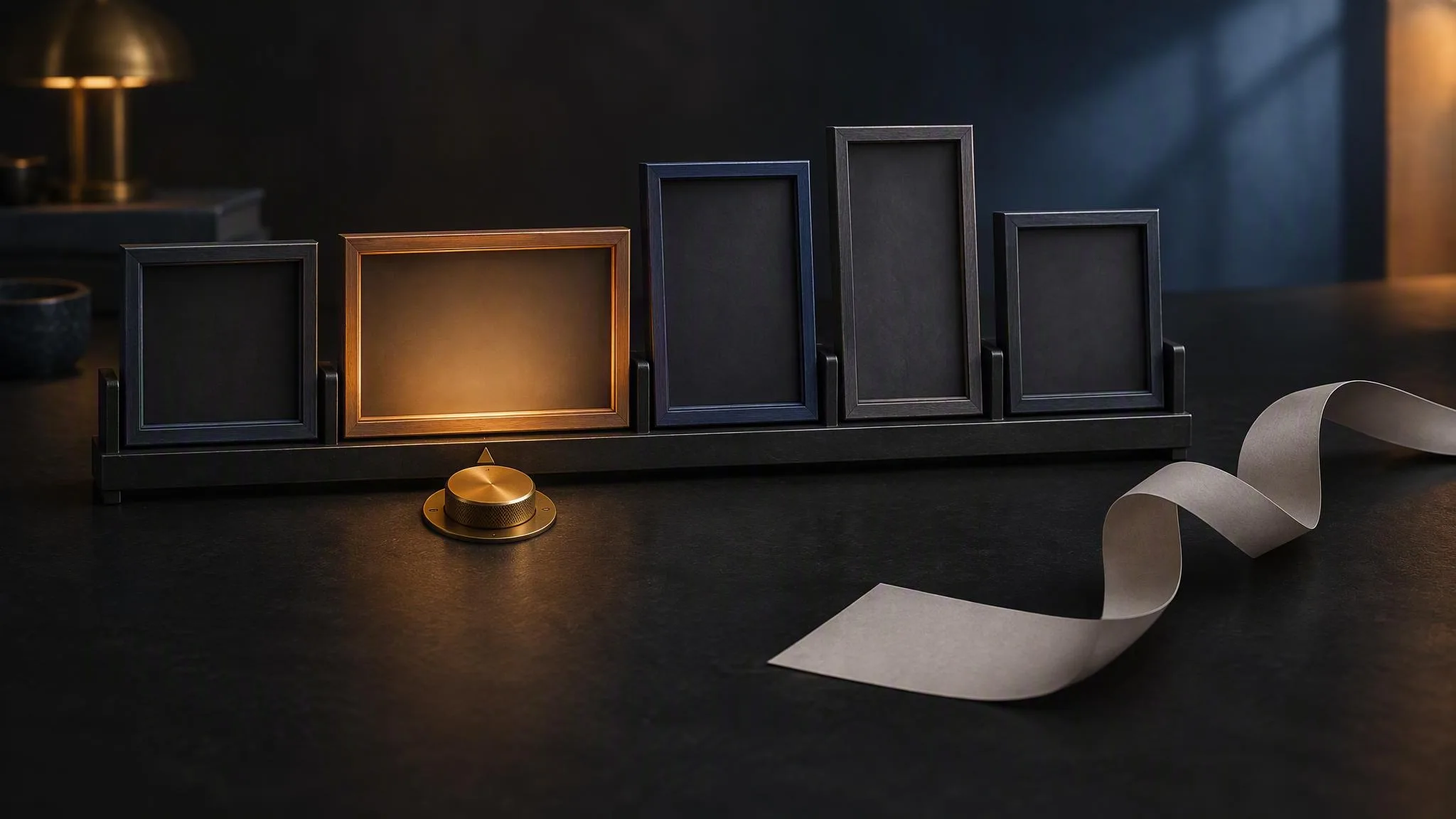
Seedream 5.0 Pro is ByteDance's current image model, described by its makers as "a multimodal image generation model that features advanced reasoning and efficient content creation." On LUVI it runs as text-to-image and edit, at 144 credits per image. Before any of the craft matters, there is one parameter that trips up nearly everyone arriving from another image model: this family has no aspect ratio setting at all.
Where does the aspect ratio live?
In the size parameter, written as WIDTH*HEIGHT with an asterisk, not an "x" and not a ratio. The default is 2048*2048, which is why so many first Seedream images come back square when the person wanted a banner.
Typing "16:9" into the caption does not help. The prompt check flags it with the model's own rule: aspect is set with the size parameter, never a ratio in the caption. The ratio is simply read as part of the description and ignored.
Which sizes are legal?
Thirteen values, across two resolution tiers—a 1.5K tier up to about 2.36 megapixels and a 2K tier up to 2048×2048, which is about 4.19 megapixels. Grouped by shape:
- Square:
1024*1024,1536*1536,2048*2048(the default). - Landscape:
2304*1728(4:3),2496*1664(3:2),1776*1328(4:3 at the smaller tier),2048*1152(16:9),2720*1530(16:9 at the widest). - Portrait:
1728*2304,1664*2496,1328*1776,1152*2048,1530*2720.
Pick the pixel dimensions that match the shape you need, and leave the ratio out of the prose entirely. A value that does not match one of these strings exactly—including the asterisk—is dropped, and you get the square default.
What does the thinking switch do?
Seedream 5.0 Pro carries a thinking parameter, enabled by default, which runs a deep-thinking prompt-optimization phase before the image is drawn. Setting it to disabled produces a faster generation.
That phase is the visible edge of what ByteDance describes as the model's reasoning: its launch post says 5.0 Pro "delivers across-the-board improvements in foundational capabilities such as image-text alignment, structural coherence, text rendering, and visual aesthetics," and that it can "accurately transform data, concepts, and dense text into professional layouts." If you are generating a layout-heavy image—an infographic, a poster, a packaging front—leaving thinking enabled is the setting that pays for itself.
How should the caption be built?
As a finished caption in prose, not a pile of tags, and in priority order—because Seedream is lead-weighted: concepts mentioned earlier weigh more. Put what must survive in the first clause and the negotiable detail last.
The order our manual gives is subject, then scene and setting, then composition and framing, then style, then lighting and atmosphere, then camera and lens. Thirty to a hundred words is the sweet spot.
A weathered fisherman in a yellow oilskin coat mends a net on a harbour wall, the Aegean behind him at first light, medium shot with his hands as the focal point, editorial photography, low warm sun from frame-left with cool shadow fill, 85mm, visible pores and fine lines, matte skin.
Two things that carry unusual weight on this family: in-image copy goes in double quotes and in the target script—actual glyphs, never romanized, because unquoted text renders as the idea of a sign rather than the words. And "photorealistic rendering, ultra-detailed, commercial quality" produces a clean CGI look, which is right for products and wrong for faces. For a photograph, describe a capture and name a genre instead.
Why did my edit change the whole frame?
Because on Seedream, generation and editing are one unified model and an edit regenerates the entire frame. "Keep the font unchanged" is guidance to imitate, not a pixel lock, and it should never be read as a promise that a real photograph survives untouched.
That makes the edit grammar specific: name what changes and name what to hold, both with a concrete end state. "Make it better" does nothing. With several references, address each image by index paired with a noun—"apply Image 2's style to Image 1"—and repeat load-bearing descriptions word for word to hold identity across the change.
How we checked
- Models:
bytedance/seedream-v5.0-pro/text-to-imageand/edit, with the v5.0 Lite and v4.5 rows for comparison. - Settings: all thirteen
sizevalues,thinkingenabled and disabled,output_formatjpeg and png. - Date and what was read: September 22, 2026. Model schemas and credit estimates from LUVI, the prompting guide LUVI runs for this family, and the ByteDance Seed pages linked below.
- Results: 144 credits per image, confirmed against the live model page and a live estimate. The schema exposes no aspect ratio parameter;
sizedefaults to2048*2048. A caption containing "16:9" plus the five noise tokens came back with one rewrite—all five deleted in a single pass—and one warning about the ratio. - Drawbacks: No outputs were generated for this post, so it makes no claim about output quality. BytePlus renders its API parameter tables in a way our fetcher could not read, so the
sizevalues above come from LUVI's live schema rather than from a vendor table.
In LUVI
Choose Seedream 5.0 Pro in the Workspace, set size before you write anything, then press the feather button next to the prompt. That is LuviTransLex, the free check that applies this family's prompting guide.
It is worth running on any caption that carries habits from another model. A vintage travel poster for the Turkish coast, 16:9, masterpiece, best quality, 8K, ultra-detailed, trending comes back as A vintage travel poster for the Turkish coast, 16:9 with a warning about the ratio: all five noise tokens are deleted in one move, because on Seedream they are inert at best and degrading at worst. The ratio stays in the text as a warning rather than a rewrite—the fix for it is the size parameter, which the check cannot set for you.
There is no Negative Prompt field here either, and when a model has one is decided by the model rather than by a setting. The whole family is reachable from Claude or ChatGPT through the LUVI connector.
New here? Create a LUVI account and make your first image a non-square one, just to feel where the shape actually comes from.
Sources
- Seedream 5.0 Pro — ByteDance Seed, model page. Accessed September 22, 2026.
- Beyond generation, it understands design: introducing Seedream 5.0 Pro — ByteDance Seed, blog, July 8, 2026. Accessed September 22, 2026.
More from Guides
- How to prompt Hailuo: fifteen camera commands, written in square bracketsHailuo takes its camera direction as a bracketed command from a closed list of fifteen, placed inline where the move happens—[Push in], [Tracking shot], [Static shot]. It is also picture only, so every word you spend on sound is wasted. Six seconds start at 380 credits.
- How to prompt Wan 3.0—name the camera in every shot, or it cuts for youWan 3.0 reads an additive formula—entity, scene, motion, then the look, then the sound—and it renders audio in the same pass. Leave the camera unnamed and it will cut inside a clip you wanted as one take. Five seconds runs from 400 credits at 480p.
- Hunyuan3D doesn't read your prompt: on image-to-3D, the picture is the whole briefOn Hunyuan3D's image-to-3D modes the text field is not read at all—the model's own contract says it accepts no prompt. Every bit of control you have is in how you prepare the input image. Meshes start at 600 credits on Rapid and 1,000 on Pro.